Can Ultrasonic Brewing Match Espresso Quality While Using Less Energy?
UNSW Sydney researchers showed ultrasonic brewing matches espresso quality at room temperature in under 3 minutes while cutting energy use by ~75%, confirmed by blind taste tests with 100 consumers.
Ultrasonic espresso is defined as a brewing method that couples high-intensity sound waves directly into a standard espresso filter basket to extract espresso-strength coffee from room-temperature water in 2–3 minutes — and a peer-reviewed study published June 1, 2026 in the Journal of Food Engineering confirms it can match conventional espresso on every measurable dimension while consuming only 24.3% of the energy of a traditional single-group espresso machine.
Dr. Francisco Trujillo's team at UNSW Sydney's School of Chemical Engineering has now published two major studies on ultrasonic coffee brewing. Their first, covered in May 2024, compressed cold brew's typical 12–24-hour steep into under three minutes — but produced a dilute, cold-brew-style beverage. This new work tackles a harder problem: reaching espresso-level concentration and extraction yield without any heated water.
| Metric | Ultrasonic Espresso | Conventional Espresso | Difference |
|---|---|---|---|
| Brew water temperature | Room temp (~22 °C) | ~90–96 °C | ~70 °C lower |
| Brew time | 2–3 minutes | ~25–30 seconds (active) | Comparable total cycle |
| Extraction yield (finest grind, ~325 µm) | 18.03% | 16.26% (no ultrasound) | +1.77 pp; enters SCA ideal zone |
| Energy use (3 beverages, 20-min window) | 0.020 kWh | 0.0823 kWh | ~75% reduction |
| Consumer preference vs. conventional | No significant difference | — | Statistically equivalent |
| Caffeine content | No significant difference | — | Statistically equivalent |
| Chlorogenic acid (antioxidant) | No significant difference | — | Statistically equivalent |
How does ultrasonic brewing actually work?
Acoustic cavitation — the rapid formation and violent collapse of microscopic bubbles in a liquid when exposed to high-intensity sound waves — is the engine behind ultrasonic espresso.
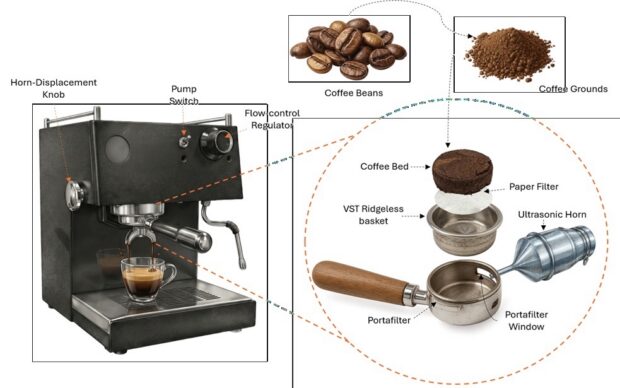
In the UNSW system, a transducer presses against the side of a standard portafilter basket and causes it to vibrate at ultrasonic frequencies, far above human hearing range. These vibrations propagate through both the coffee grounds and the water percolating through them. Where pressure waves are most intense, microscopic bubbles nucleate and then implode in nanoseconds, generating localized jets of liquid that pit and fracture the surface of coffee particles, dramatically increasing the surface area available for extraction.
Flavor compounds, oils, and caffeine migrate into the water far faster than thermal diffusion alone could achieve at low temperature. The team developed a novel resonant horn design specifically to excite dominant resonance modes in the coffee basket, creating multiple cavitation zones simultaneously and stabilizing generator operation — a key engineering advance over earlier prototypes.
Acoustic-cavitation principles have been applied to coffee before. Commercial devices including the Osma Pro and the Sonic Dutch Supersonic S1 brought related technology to market, though neither appears to be actively sold today. Industrial ultrasonic processors from companies like Hielscher have also been used to accelerate cold brew extraction, compressing steeping time from 24 hours to seconds in laboratory settings. What distinguishes the UNSW work is the direct coupling of ultrasound into the filter basket during active water percolation — a configuration that enables espresso-strength, not merely cold-brew-strength, output.
What do the extraction numbers actually mean?
Total dissolved solids (TDS) and extraction yield (EY) are the two primary quantitative benchmarks used to evaluate espresso quality. TDS measures the concentration of dissolved material in the final cup; EY measures what share of the soluble solids in the ground coffee actually made it into the water.
The Specialty Coffee Association defines the ideal EY range as 18–22% — the zone associated with balanced extraction, where neither under-extracted sourness nor over-extracted bitterness dominates. Hitting that window with cold water, without pressure, had not previously been demonstrated at espresso concentration.
At the finest grind setting tested — approximately 325 microns — the ultrasonic system reached 18.03% EY, just clearing the SCA threshold. The identical setup run without ultrasound reached only 16.26% EY. Across every coarser grind setting tested, the no-ultrasound control consistently failed to reach the optimal zone even with extended brew times. The ultrasonic system also matched conventional espresso on TDS, with both methods producing approximately 8.7–8.9% TDS when the comparison was normalized for beverage strength.
These numbers represent the first peer-reviewed demonstration that room-temperature, pressure-free brewing can achieve espresso-grade extraction — not just a concentrated cold brew approximation.
How significant is the energy saving?
Producing three beverages at matched strength over a 20-minute window, the ultrasonic system consumed 0.020 kWh versus 0.0823 kWh for a conventional single-group espresso machine — meaning the ultrasonic setup used roughly one-quarter of the energy.
The authors note that this comparison excludes the startup heating time for the conventional machine. In a domestic setting, where a machine heats up for a single shot and then cools down, the conventional machine's energy penalty is larger than the study's figures suggest. In a commercial café environment, where a machine stays hot all day, the gap narrows somewhat — though the ultrasonic system still wins on a per-shot basis.
Dr. Trujillo framed the industrial implications explicitly: "There are companies that make coffee products on an industrial scale and we are confident this ultrasound system can be scaled up to meet their needs, delivering real benefits in terms of reduced processing times and energy use." Because the process produces a concentrated, espresso-strength output, it can be used directly to manufacture ready-to-drink products, or shipped as a concentrate and later diluted into cold brew or milk-based drinks — a supply-chain advantage that goes beyond simple energy accounting.
Coffee roasting and brewing collectively represent a meaningful share of the beverage industry's energy footprint. A 75% reduction in brewing energy, applied at industrial scale to ready-to-drink coffee production, would translate into substantial absolute savings even if the per-cup figures sound modest.
Could 100 coffee drinkers tell the difference?
One hundred untrained coffee consumers evaluated four samples in the sensory study: traditional espresso, ultrasonic espresso, traditional pourover, and ultrasonic filter coffee. All samples were served at room temperature — approximately 22°C — to prevent the serving temperature itself from signaling which method was used.
The authors acknowledged this as a limitation. In real-world café or home contexts, espresso is typically served hot, and temperature is itself a sensory variable. The study's design controls for method but does not replicate typical consumption conditions.
No significant differences in aroma, flavor, bitterness, or overall liking were detected between ultrasonic espresso and conventional espresso (p > 0.05 across all hedonic attributes). The two preparations were statistically indistinguishable to untrained palates in a blind test.
The filter coffee result proved more interesting. Sixty-one percent of participants preferred the ultrasonic filter coffee over conventional pourover, with only 7% expressing no preference. That result was statistically significant (p < 0.05), driven primarily by bitterness and overall sensory appeal. Ultrasonic processing appears to moderate bitterness in filter-style brewing more noticeably than in espresso-style brewing — possibly because the baseline bitterness of conventional pourover is higher relative to the espresso comparison, giving the ultrasonic method more room to differentiate.
What did the chemical analysis find?
Beyond sensory testing, the study ran chemical analysis on caffeine concentration, chlorogenic acid levels, color, pH, and headspace volatile profiles. Chlorogenic acid is a group of naturally occurring antioxidant compounds in coffee that have been associated with various health-relevant properties, including antioxidant activity and potential effects on glucose metabolism.
No statistically significant differences were found between ultrasonic and conventional espresso on any of these markers (p > 0.05). Caffeine content was equivalent. Chlorogenic acid concentration was equivalent. Volatile compound profiles — the aromatic fingerprint of the coffee — showed no significant overall differences under the tested conditions.
This chemical equivalence matters as much as the sensory result. Ultrasonic brewing is not achieving extraction by selectively pulling out certain compounds while leaving others behind. The extraction profile appears to be broadly similar to thermal-pressure brewing, just achieved through a different physical mechanism. That matters for health-conscious consumers who drink coffee partly for its antioxidant content, and it matters for product developers who need consistent chemistry across batches.
If you're thinking about caffeine intake more broadly — for instance, whether matching espresso caffeine levels fits your daily consumption goals — our guide on how to drink coffee all day without jitters covers caffeine modulation strategies in detail.
What are the real-world limitations right now?
The study is a proof-of-concept, not a product launch. Several gaps remain between the laboratory sonoreactor and a device you could buy or a factory could install.
Serving temperature is unresolved for home use. Espresso is culturally and sensorially a hot beverage. Serving it at 22°C is fine for a controlled experiment but not for a morning routine. The ultrasonic system would need to be paired with a downstream heating step — or the consumer would need to accept room-temperature espresso — for domestic adoption. This is not a fundamental barrier, but it adds system complexity and partially erodes the energy advantage.
The patent (WO2025/118023A1, assigned to UNSW) is pending, not granted. Commercialization timelines for academic brewing technology have historically been long. The Osma Pro and Sonic Dutch Supersonic S1, both of which used related acoustic-cavitation principles for cold brew, appear to have exited the market without achieving mainstream adoption.
The sensory panel used untrained consumers. Specialty coffee professionals — baristas, Q graders, competition judges — have trained palates that may detect differences untrained consumers miss. The study does not claim the two methods are indistinguishable to experts, only to a general consumer population.
The energy figures exclude startup heating for the conventional machine. While this is methodologically defensible for a controlled comparison, it means the 75% figure is a lower bound on the real-world domestic saving, not an upper bound. In commercial settings with continuous machine operation, the gap is smaller.
What does this mean for the coffee industry?
Ultrasonic espresso's most immediate commercial application is probably not in cafés but in ready-to-drink (RTD) coffee manufacturing.
RTD coffee is one of the fastest-growing segments of the global beverage market. Producing espresso concentrate at industrial scale currently requires significant energy for water heating and pressure generation. A process that cuts energy consumption by 75% while maintaining equivalent chemistry and sensory profile would represent a meaningful cost and sustainability advantage for RTD manufacturers — and Dr. Trujillo's team has explicitly framed the technology with that application in mind.
For specialty cafés, the picture is more complicated. The cultural ritual of espresso — the crema, the heat, the pressure-driven extraction — is part of the product. A room-temperature ultrasonic shot may be chemically equivalent, but it arrives without the visual and thermal cues that customers associate with quality. Adoption in that channel would require either consumer education or a hybrid system that heats the output.
The filter coffee result — where ultrasonic brewing was significantly preferred over pourover — may actually be the more immediately actionable finding for café operators. A device that produces preferred-tasting filter coffee faster and with less energy than a conventional pourover setup is a simpler sell than a cold ultrasonic espresso shot.
Where does this research sit in the broader ultrasound-in-food space?
Ultrasonic processing — the application of sound waves above 20 kHz to food systems for purposes including extraction, emulsification, homogenization, and preservation — is an established industrial technique in food science, used in everything from fruit juice clarification to dairy homogenization.
Its application to coffee is newer but not novel. Hielscher Ultrasonics has documented ultrasonic cold brew extraction using probes like the UP200Ht and UP400St, reducing cold brew steeping from 24 hours to seconds in batch configurations. The UNSW team has advanced the technique from batch cold brew to continuous-percolation espresso-strength brewing, with a novel resonant horn design that improves energy transfer efficiency and generator stability — engineering refinements that make the process more viable at scale.
The study's publication in the Journal of Food Engineering (DOI: 10.1016/j.jfoodeng.2026.113193) under open-access Creative Commons licensing means the full methodology is publicly available, which should accelerate follow-on research and independent replication. That transparency signals the team's confidence in the results.
The pending patent creates a commercialization pathway, but also a potential bottleneck: any manufacturer wanting to use this specific resonant-horn design would need to license from UNSW. Whether the university pursues an exclusive licensing deal with a single manufacturer or a broader licensing strategy will significantly shape how quickly the technology reaches consumers or industrial users.
Ultrasonic espresso remains a laboratory achievement with compelling numbers and a clear commercial logic. The 75% energy reduction is real and reproducible. The sensory equivalence is real, with the noted caveat about serving temperature. The path from sonoreactor to your kitchen counter or a factory floor is not yet mapped — but the destination looks increasingly worth reaching.
Last verified: 2026-06-11
Sources
- Researchers Say Ultrasonic Brewing Can Match Espresso, Reduce Energy — Daily Coffee News
- Ultrasound enables espresso-strength coffee brewing in 2–3 minutes at low temperature with lower energy consumption — Journal of Food Engineering (ScienceDirect)
- Entirely new way of making espresso shakes up the coffee world — TechXplore / UNSW Sydney
- Ultrasonic Cold Brew Coffee — Hielscher Ultrasonics
- UNSW Sydney School of Chemical Engineering
- Through Sound, Scientists Transform Espresso Machine Into Quick Cold Brewer — Daily Coffee News (2024)